TWIBH: January 13, 1976 — Hagler vs. Watts I
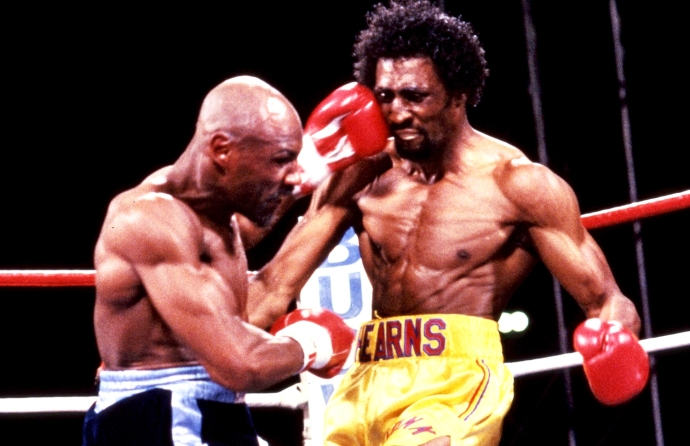
No matter where you place Marvelous Marvin Hagler in a ranking of the best middleweight champions of all-time, there can be no disputing the fact that few boxers have ever dominated a division as comprehensively and for as long as Hagler did his in the 1970s and 80s. Because of his record-breaking fourteen straight title defenses, many regard Carlos Monzon as the most dominant middleweight of his time. But Hagler, who ascended the ranks just as Monzon retired, was clearly the best for longer, close to a full decade. While he would not win a world title until September of 1980, long before then boxing observers knew he was the top middleweight in the world, a dangerous and highly skilled southpaw who no one wanted to fight and who was robbed by the judges in his title match with Vito Antuofermo the year before. After finally winning the championship from England’s Alan Minter, he would reign supreme until 1987.
Long before Hagler reached the top, no less a luminary than Joe Frazier had warned Hagler he would have a difficult time securing opportunities for himself. According to the former heavyweight champion of the world, Hagler had three strikes against him that spelled trouble: he was black, a southpaw, and good. Of course Hagler would eventually prove to everyone how “good” he was, but a long, hard road had to be journeyed before the general public would acknowledge his greatness. In the 70’s there was little recognition for Hagler beyond the fight writers and hardcore boxing fans, despite the fact that by 1978 he had defeated more quality opponents than anyone else.
It was fitting that Frazier of all people gave Hagler the news on the struggle that lay ahead because the hard road Hagler took to the championship went straight through Smokin’ Joe’s adopted home of Philadelphia, the toughest city in all of boxing at the time. Hagler and his managers, the Petronelli brothers of Brockton, Massachusetts, sized up the situation and recognized that the “City of Brotherly Love” was a hotbed of fistic talent and home to some of the best middleweights in the world. If Hagler wanted to get to the top, it meant venturing into Philly to prove himself against the very best. It was a risky move, but as Goody Petronelli would put it years later, “We knew if we were going to get anywhere we had to fight ‘the iron.’ So we went to Philadelphia.”
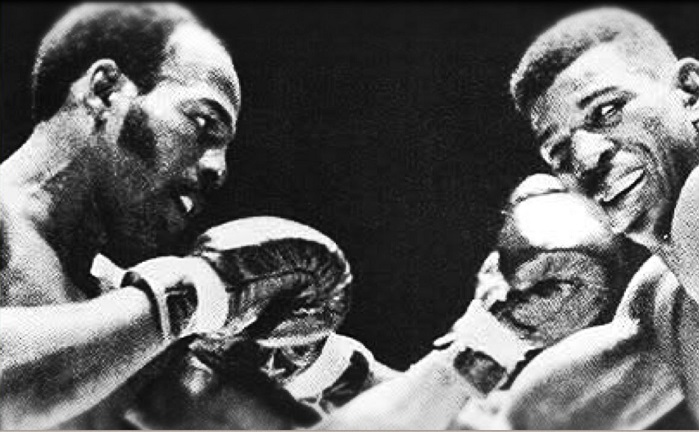
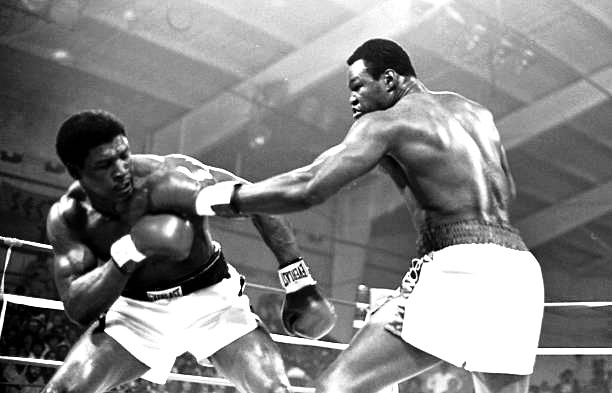
Hagler (right) mixes it up in the Philadelphia Spectrum with one of the toughest of Philly fighters, Bennie Briscoe.
When Hagler strode down the aisle of the Philadelphia Spectrum for the very first time, he was undefeated in 26 fights. His opponent, Bobby “Boogaloo”Watts, a tall, rangy scrapper with quick hands and a sharp jab, was five years older and more experienced. It was a tough test for Marvin but one he had to pass in order to graduate to facing some of the top contenders, fighters like Mike Colbert, Eugene Hart and Bennie Briscoe. Philly fight fans demanded action and they got it that night as Watts and Hagler staged a fast-paced and bruising battle, both men giving their all. It was clear Hagler had the edge in terms of aggressiveness, strength and power, but Bobby Watts was from Philadelphia and so were the ringside officials. While Marvin clearly deserved the win, after ten rounds the judges gave the decision to Boogaloo. The verdict was bad enough to prompt J. Russell Peltz, the Spectrum’s boxing promoter, to actually go over and apologize to Hagler’s people.
“It might not have been the worst decision of all time,” Peltz would say later, “but it was pretty bad.”
So bad, that after the decision had been announced and Watts had left the ring, the Philly fans actually gave Hagler an ovation. And the next morning, there was the perfect headline in The Philadelphia Inquirer: “Welcome to Philadelphia, Marvin Hagler!”
Hagler refused to let the setback discourage him. He was back in the win column less than a month later, and back in Philly for another tough fight, and another close decision loss, this time against Willie “The Worm”Monroe. A lesser fighter might have resolved right then and there to forever stay far away from the mean streets of Philadelphia, but not Hagler. A series of wars at the Spectrum would soon follow, with Hagler avenging his loss to Monroe not once, but twice, and scoring big wins over Eugene Hart and “Bad” Benny Briscoe. Those fights constituted Hagler’s baptism of fire, the tough battles that brought out the best in him and moulded him into the great champion he would soon be. Hagler may have learned to box in Brockton, Mass. but it was in Philadelphia that he became “Marvelous.”
As Bobby Watts would eventually find out. In April of 1980 Hagler and Watts finally met again and this time the judges might as well have stayed at home. Marvelous Marvin stopped Boogaloo Bobby in round two. – Michael Carbert