Best Boxing Blog

Lively summer forecast for Canadian boxing

May 19

Pier-Olivier Cote looks to take a major step forward.

With a handful of exciting fighters making comebacks and some prospects taking the next step forward, it’s shaping up to be a very exciting summer for Canadian boxing fans.

Cote Back in Action on Bute-Froch Undercard: After being out of action for nearly seven months, Pier-Olivier “Apou” Cote finally makes his return to the ring next weekend against the hometown favourite Mark Lloyd. While Lloyd has only a modest 15 wins in 20 pro bouts, fighting in front of a hostile crowd should prove to be a great experience for the young IBF Intercontinental champion. After an undisclosed illness forced Apou to pull out of a promising bout against Mauricio Herrera earlier this year, the young Canadian is extremely excited to step back into the ring and continue his rapid progression through the 140 pound division.

IBF Sanctions Pascal-Cloud Title Bout: The IBF announced this week the sanctioning of the upcoming title fight between Laval native Jean Pascal and undefeated champion Tavoris Cloud. There were concerns that the fight might not take place, as Karo Murat was the mandatory challenger, but everything seems to be resolved and the winner in all likelihood will be forced to fight Murat shortly after their bout. According to promoter Yvon Michel, all the details will be finalized when he flies to Los Angeles next week to meet with Cloud’s promoter Don King.  While the venue for the event has yet to be officially announced, Jean-Luc Legendre of RDS suggests Quebec City is the likely venue for the fight.

It's make or break for "The Storm" on June 8.

Alvarez Steps Into the Spotlight: Groupe Yvon Michel has announced that Eleider “Storm” Alvarez will be headlining this season’s final edition of the ever popular “Rapides et Dangereux” series. The June 8th event marks the first time Alvarez headlines a card, and his opponent Shawn “The Sioux Warrior” Hawk will be looking to not only spoil the show, but to strip Alvarez of his NABO light heavyweight title. With only one loss in 25 pro bouts and 16 knockouts inside three rounds, Hawk is a huge step up for the undefeated Alvarez who has yet to be truly tested in his young pro career. While Eleider has gained a reputation for being one of the light heavyweight division’s most promising young prospects, an impressive win over “The Sioux Warrior”could put him in the discussion for a major title shot very soon. GYM has also announced that the “Rapides et Dangereux” series will be back for a third season starting sometime in the fall.

Sylvera Louis  and Oscar Rivas  in a Canadian heavyweight showdown: Also on the June 8th “Rapides et Danereux” card, two of Canada’s best heavyweights will face off, the winner to be in a perfect position for a shot at the Canadian championship. Rivas (10-0) and Louis (4-1) come into the bout ranked two and four in Canada. Louis publicly challenged Rivas a few weeks ago and the fight was on. This should be an exciting match.

Lemieux needs a fresh start.

Lemieux Out to Prove He’s Learned His Lesson: 14 months ago, David Lemieux was recognized as one of boxing’s brightest young prospects, after a string of impressive highlight reel knockouts against world class fighters Elvin Ayala and Hector Camacho Jr. With an unblemished record of 25 wins(24 coming by KO) and a WBC title eliminator bout against Marco Antonio Rubio, the sky was the limit for the 22 year old Montreal native. But after a shocking 7th round KO at the hands of Rubio, Lemieux spent the next several months away from the sport.

When Lemieux finally made his way back to the gym, he swore he had learned from his defeat and when he stepped into the ring that December against former world champion and fellow Quebec native Joachim Alcine, we would see a whole new fighter. While he had cut most of the baby fat that he carried through the earlier parts of his career and made a managerial change letting go of Russ Anber, the fight went eerily similar to his previous bout against Rubio. Under new trainer Marc Ramsey’s tutelage, David once again came out strong but faded in the second half to lose a close majority decision to a very game Alcine.

Here we are over 17 months and two disappointing losses since Lemieux’s last win, and the Canadian begins his journey back to the top with a June bout against Jaudiel Zepeda on the undercard of the June edition of “Rapides et Dangereux“. While the Mexico native shows a modest 12 wins in 18 bouts,  the fact that he’s only been stopped once in his career makes him an intriguing adversary for the comeback bout.           

– Dustin Alexander


TWIBH: May 15, 1992 — Moorer vs. Cooper

May 18

Moorer in his prime.

Michael Moorer and Bert Cooper were at different stages of their careers when they met for the vacant WBO heavyweight title in Atlantic City. If the 28-0 Moorer was an exciting fighter on the ascent, the Joe Frazier-protégé Cooper was a capable journeyman who’d already lost eight times. Cooper’s shot at Moorer was largely made possible because of his impressive performance in a bout six months earlier against heavyweight champion Evander Holyfield. Cooper exceeded expectations by giving “The Real Deal” one of his toughest fights, even scoring the first knockdown of Holyfield’s career before being finally stopped in the seventh round. Cooper proved himself a tough and game competitor and a match with Moorer promised to be a war.

The upstart Moorer, after all, was an exciting, action-oriented fighter as well. A product of Detroit’s Kronk Gym, which manufactured championship caliber boxers more efficiently than the city’s factories did cars. Moorer almost always won by stoppage as he possessed both terrific power and that essential instinct of knowing exactly when to ratchet up the relentlessness. He obliterated the competition in his first four years as a professional, winning all but two fights by knockout. Of his former pupil, trainer Emanuel Steward said in 2003 that “Michael Moorer was definitely one of the greatest light heavyweights… in the history of boxing.” Moorer’s talent was obvious, but his character was marked by an unwillingness to follow direction, and it’s possible (somewhat paradoxically, given his profession) that his in-ring aggression was too pronounced. “Smokin’” Burt Cooper’s own aggressive, hard-punching approach was certain to provide the violence Moorer craved.

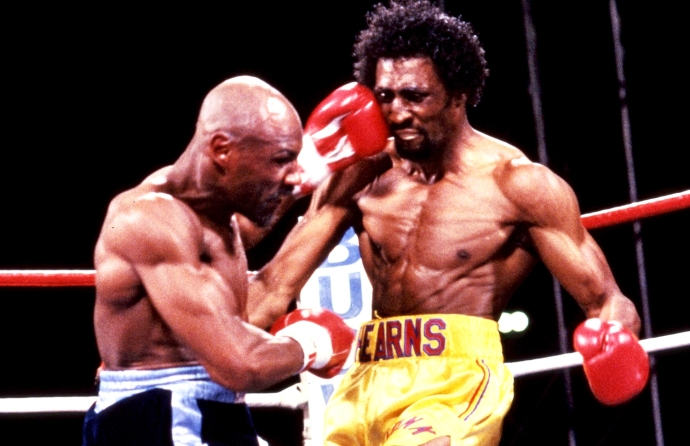
From the opening bell, it was obvious Cooper was prepared to throw down. Hostile and hard-charging, the shorter, stockier Cooper drew upon his inner Joe Frazier, punching ferociously from the outset. He pressed Moorer against the ropes with his classic brawling style and scored a knockdown forty-one seconds into the first round when a thunderous series of power punches left Moorer crumpled against the ropes. The former light heavyweight champion was so dazed that even before going down he appeared out on his feet.  Impressively, Moorer wasn’t ruined by this poor start, and fought his way out of the corner when Cooper tried to finish him, fighting back effectively enough to drop Cooper with a flush shot to the chin, evening the knockdown count at one. The action in this first round was so compelling, and its pace so frenetic, that by its end the crowd was cheering with amazing intensity, clearly thrilled at having witnessed three minutes of combat that rivalled the opening round of Hagler vs. Hearns.

Cooper impressed with his valiant effort against Holyfield.

In the second round the irrepressible Cooper would retrieve the momentum, throwing fierce, powerful punches. When heavy blows weren’t being exchanged, both men fought in tight proximity to one another, with their heads touching and Moorer’s back invariably against the ropes. Cooper would carry this energy into the third round, when, punching feverishly, he dropped Moorer again. Showing his mettle, a woozy Moorer got up and boxed his way back, doing most of his punching close to the ropes where he could get inside and look to throw an uppercut.

In the fourth round the action, astonishingly, intensified, with both men landing vicious shots. Cooper’s right eye was bleeding badly, and his already round face had become inflamed by the mounting damage; its shape was an indictment of his inability to defend against Moorer’s power punches. Nevertheless, his worsening physical condition did little to quell his willingness to compete. Cooper would again start the fifth round emphatically, cornering Moorer as he continued to swing away. He had swung so hard, in fact, that he punched himself out, and barely had the requisite energy to keep his hands up. Cooper was now vulnerable, and Moorer seized his opportunity, coming out of the corner to spin Cooper and assemble a gorgeous combination that ended in a right uppercut to Cooper’s undefended chin, sending him down and almost through the ropes. Cooper managed to get up, but he was clearly finished and the referee wisely called a halt as a battered but triumphant Moorer was congratulated by his soon-to-be ex-trainer Emanuel Steward.

This fight was not an excellent display of technical boxing, but remains memorable for its chaotic energy and reverses of momentum. Moorer simply let his opponent exhaust himself, saying as much in his post-fight interview, and likely to the chagrin of Emanuel Steward, whose strategic advice he appeared to ignore. Ironically, the man who would hand him his first loss, George Foreman, knew firsthand the perils of succumbing to such a strategy, and employed a variation of this tactic against Moorer in their 1994 championship bout, when he patiently waited for his one shot and knocked out the much younger, more able champion. Moorer, once the teacher, chose an inopportune time to forget his own lesson.                 — Eliott McCormick


One Night in Mississauga, Part 2

May 17

Photos by Jess McCauley.

Just in time, the big boys come out, “Dangerous” Denton Daley taking on Frank White, cruiserweights, and they look tough. White’s bald, tatted-up biker-style, while Daley’s got the more sculpted physique. Daley’s the more confident fighter, but White’s fearless, gives him a good challenge. He seems slightly unhinged as he screams before throwing each punch, which makes it a bit easier for Daley to dodge the shots and time his footwork. By the fourth round, White’s face is red, blotchy, blood starting to flow. In the fifth, Daley has White lined up right in front of where I’m sitting, maybe two feet away. Each punch sends a spray of blood and sweat over the ropes and I have to cover my beer with my notebook. White keeps coming though, trying, even with this goose-egg swelling around his eye, his face just a mess. After six, he doesn’t come out for the next round. Daley takes it, deserves it.

Sitting just a few seats away from me is Donovan “Razor” Ruddock, the old heavyweight. He’s looking pure ‘80s, with a neon yellow tanktop, hair shaved along the sides and spiked on top. During all the fights he’s been throwing punches in his chair, flexing his arms, guess he wants people to know he’s there. He’s 48 years old and planning a comeback. Good luck, pal.  Steve Molitor’s hanging around ringside too, but more low-key, wearing a Team Vargas shirt.

It’s been a pretty quick night. It’s not even eleven and time for the main event, Meacher Major taking on NABA Superfeathweight Champ Logan Cotton McGuinness, the guy I came to see, my new favourite fighter after meeting with him the week before. I genuinely like the kid and want to see him put a hurt on the cocky Major. Before we left the hotel room, Jess and I lit a High John The Conqueror candle, asked for luck, power, and strength for Logan in the ring tonight. I’m not a superstitious guy, but saw the candle at the West-Indian grocery, figured it couldn’t hurt.

Hershey Centre gets dim, music starts pumping. Meacher Major enters the ring looking gangster, hat cocked to the side, bouncing. Takes his shirt off, shows off the “No Limit” and “Thug Life” tattoos. Logan enters with Irish colours, flashy green trunks and robe with pale orange highlights. The crowd goes crazy. The fight’s set for 12 rounds. I’m psyched and not shy to show where my allegiance lies. I got my pen in my mouth, clapping for McGuinness as the announcer bellows his name.

McGuinness vs. Major: Round 1.

At the bell, Logan works his jab like he told me he wanted to. Major is quick, but not landing anything. Logan testing the waters a bit, but you can see his desire to come forward is pulling on him. Major’s not the aggressor that Team McGuinness thought he was, and Logan starts pressing. Gets Major against the ropes and he’s lining up some fierce shots. There’s good exchanges going on, but McGuinness has control. Then wham, a thunderous right hand and Major’s on his ass. He gets up, ref giving him the standing eight, but he looks shaky. Ref tells him to raise his gloves and he does it gingerly, almost meekly. He’s hurt, dazed, and just barely makes it to the bell.

Logan sitting on the stool, staring straight ahead and everyone just waiting for the fight to start again. We know the second round’s going to be explosive, Logan looking for the kill. At the bell he charges, quickly has Major back on the ropes. He’s stopped trying to play defense altogether, and is just looking for the one big punch that will put Major out. Because of this, Major manages to get off a few shots, even opens a cut above Logan’s eye. The blood comes fast, but so does Logan and Major can do nothing to stop him. He’s trapped in his own corner and McGuinness just pours it on. Finally, the ref steps in, a couple minutes into the second. Logan is the winner by TKO and I get out of my chair to cheer him.

Jess and I mill around the ring for a bit after the fight, both happy and buzzing from Logan’s victory. She snaps some shots of him with the belt, him posing with a kid and his trainer RG. I make eye contact with that other photographer again, Uncle Fester, and give him a nod. He comes over to talk. We do a little introduction, talk about the fight a bit. The dude is bitter, jaded. Says he likes taking pictures of the gangsters and characters sitting around the ring even better than what’s going on inside. Says all these guys in their fancy suits don’t impress him.

“Don’t you see how fucked up it all is? Don’t you see the corruption?” I guess he’s saying it to me, but kind of looking at Jess more. Really he’s just talking to himself. Somehow we get away and Jess and I slip through the crowd, exit the Hershey Centre and walk through the barren suburban landscape that is Mississauga. We get back to the room before midnight, order pizza and drink what’s left of the beer while watching a show about storage lockers and the people who love them.

In the morning, I figure out a way to tie the bumper back on the car using one of those things you wear around your neck to hold your keys with. I drink coffee in the passenger seat while Jess drives, the window open and my arm hanging out. My phone buzzes, tells me I have new email, a notification that the photographer from the night before, the bitter one who loved Jess, has added me as a friend on Facebook. Jess tells me later he added her too. As if I give a shit.        – David Como 


One Night in Mississauga, Part 1

May 16

Junmar Emon takes the fight to Peron. (Photos by Jess McCauley)

The front bumper fell off Jess’ car in the hotel parking lot. She was stressed out, so we went upstairs and chugged two beers before calling a cab to the Hershey Centre. We get there, a well-dressed guy named Jason shows us our seat, or rather my seat, at ringside. Jess doesn’t get a chair, has to kneel with the photographers, arms hanging over the side of the ring. She’s out of place. The other photographers are middle-aged, rumpled, look like they live in some cave hidden away in the arena and crawled out just for the fight.

I’m at a table beside two Filipino writers. They’re geared up for the first match, the professional debut of Toronto fighter Junmar Emon, also Filipino. It’s a four-rounder, with Emon taking on Daryl Peron (0-1) from Hamilton. Fight starts and Emon’s getting pushed back by Peron, the bigger man, but Junmar lands shots. In the second, he knocks Peron down. Peron gets up, has this weird, knowing smile on his face. Cheeks red, he’s even laughing a bit. Round ends and Peron staggers back to his corner. Rest of the fight, he just leans on the smaller Emon while the Filipino lands the bigger shots. Fight ends, Emon and Peron shake gloves. Big Peron walks back to his corner knowing he’s lost, with that same weird smile on his face. Emon’s crew is up on the ropes, rallying the crowd, one of the trainers sticking his arm through the ropes to shake the hands of the two writers sitting beside me. When Emon is announced the winner, the writers shut their laptops down.

Next fight is another four rounder, Matt White (0-1) facing Dillon “Big Country” Carman (2-1) from Madoc. These guys a couple of big, hick sluggers, Carman entering to some cheesy song, “I shoulda been a cowboy …” White is fat, out-of-shape, screaming to the crowd like an ape when he’s introduced. Fight kicks off and Carman is much faster, but acts like a fool in the ring, putting his glove in White’s face, showboating. Carman landing big shots on White, who steps back, drops his gloves, telling Carman, “You ain’t got shit.  You ain’t got shit.” End of the round, White screams this to the crowd, “He ain’t got SHIT!!!” As Carman lands more big shots in the next round, White continues to signal and talk to the crowd, trying to let everyone know he’s not hurt. Yeah, okay Matt. We got you. No big surprise when he’s finished off at 2:27 of the third.

The next fight sees Steve “The Piranha” Wilcox (0-1) taking on David Aucoin (2-5). Aucoin’s got a big tattoo across his back, says “ACADIAN-MIKMAQ”, a cottage/tipi scene, so I’m rooting for him because my father’s from the east coast, Acadian roots and some Mikmaq blood mixed in their too. But I know the 32-year old Aucoin is just there to be beaten by the younger Wilcox, which he is, by unanimous decision after four. Probably the least exciting fight of the night.

Jess’ knees are sore. I keep telling her to steal one of the unoccupied chairs, but she doesn’t want to. There’s this one photographer who’s fascinated with her, looks like Uncle Fester in a ballcap. Keeps moving out of the way to give her space, goes and gets her a bottle of water. I see him whispering to one of the other camera guys, then both looking over at me. He’s proud of himself, as if I give a shit.

Vargas goes to work.

It’s hot under the lights, so Jess and I sneak outside for a few minutes. We get back in time to see middleweight Brandon“Bad Boy” Cook knock out Zoltan Surman from Hungary. Cook knocks him down three times in the second round before the ref stops it. Cook’s strong, in great shape, and ten years younger than Surman, but it’s still a convincing performance.

The next fight features a boxer I’m pretty excited about seeing work, Samuel Vargas. He’s 10-0 going into this match versus Arvydas Trizno (14-8) of Lithuania. Throughout the fight, Vargas has this wide-eyed, childlike look on his face, quite different from the low-browed squint of Trizno. Something fascinating about Vargas; he works fast, all business. After three rounds the ref raises his hand. Trizno just doesn’t come out for round four. I hear murmurs at ringside Vargas has crushed Arvydas’ cheekbone, jaw cracked, something’s broken …

Two well-dressed ladies behind me laughing about the foreigner getting his head knocked in. Brutal. I’m looking around the audience, there’s a steel fence separating those of us at ringside from the rest of the crowd. Right next to the fence are tables, and some mean looking redneck has his feet sticking through the fence, a beer resting on his stomach, his ball cap perched at a weird angle. He’s drunk, and I keep making eye-contact with him. Gets me thinking about why people come to fights, what draws them to see this kind of brutality. There’s a romance to it, some kind of timeless appeal, but maybe that’s all bullshit and it’s just pure animal bloodlust. Maybe that drunk sprawled out at the table is a more honest spectator than I am, classed-up in a blazer and slicked back hair. I’m starting to find the lights around the ring a bit dizzying, starting to analyze things too much …           — David Como


Top 12 All-Time Best Boxing Trainers

May 16

Freddie Brown and Ray Arcel (right) with Roberto Duran.

1. Ray Arcel: The last bridge between the post-Ali era and the Golden Age of boxing, the 1920s and 30s, Arcel enjoyed an unassailable reputation as a master trainer and strategist. Worked with Benny Leonard in the 1920s and Larry Holmes in the 80s. Transformed Roberto Duran from a crude slugger into one of the greatest fighters of all time. Among his many other champions: Barney Ross, Ezzard Charles, James Braddock, Tony Zale, Freddie Steele, Sixto Escobar, Billy Soose and Ceferino Garcia.

2. William Muldoon: Championship wrestler, strongman, and trainer of the legendary John L. Sullivan, Muldoon is credited with developing many of the basic techniques of boxing training. As heavyweight champion Gene Tunney declared: “All I know about training I learned from him.”

3. Charley Goldman: Trained and developed a host of terrific fighters including Lou Ambers, Marty Servo, Kid Gavilan, and Fritzie Zivic, but his greatest achievement was transforming a clumsy brawler named Rocky Marciano into the heavyweight champion of the world.

4. Ignacio Beristain: A top amateur coach for many years, Beristain went on to incredible success in the pro ranks. Renowned for the technical and strategic superiority of his boxers, “Nacho” has trained 18 world champions to date, including Guty Espadas, Juan Manuel Marquez, Ricardo Lopez, Humberto Gonzalez and Jorge Arce.

5. Amilcar Brusa: Regarded as the foremost boxing trainer of South America, Brusa has moulded no fewer than 14 world champions including Luis Mendoza, Miguel Lora, Antonio Esparragoza, and Rafael Pineda, but his most outstanding work remains his expert handling of middleweight great Carlos Monzon.

6. Angelo Dundee: A peerless motivator and excellent matchmaker, Dundee brought out the best in two of the most talented boxers who have ever lived, Muhammad Ali and Sugar Ray Leonard. Other champions he helped guide to the top include Willie Pastrano, Carmen Basilio and Luis Rodriguez.

7. Whitey Bimstein: From the 1920s to the 1960s, Bimstein worked with some of the greatest boxers in history. A partner at different times of both Ray Arcel and Freddie Brown, Whitey trained such legends as Harry Greb, Lou Ambers, Benny LeonardCarlos Ortiz, Bobo Olson and Rocky Graziano.

8. Bill Gore: The trainer of the greatest defensive fighter of all time, Willie Pep, naturally deserves ranking on this list, but Gore helped other top fighters, including Bob Foster, Cleveland Williams and lightweight champion Joe Brown.

9. Jack Blackburn: Some believe Joe Louis to be the greatest heavyweight of all time. Blackburn was the man who moulded “The Brown Bomber” into a fearsome destroyer who ruled the heavyweight division for over a decade.

10. Eddie Futch: Alexis Arguello, Joe Frazier, Marlon Starling, Michael Spinks, Riddick Bowe, Ken Norton and Larry Holmes are just some of the outstanding boxers Futch helped. As a strategist, he was responsible for the only defeats Muhammad Ali suffered during his prime, against Frazier and Norton.

11. Cus D’Amato: Floyd Patterson, Jose Torres and Mike Tyson all owe their success to the guru of Catskill, New York.

12. Harry Wiley Sr.: Wiley was the principal trainer for the greatest boxer who ever lived, Sugar Ray Robinson.

Honorable Mentions: Freddie Brown, Lou Duva, Gil Clancy, Emanuel Steward, Freddie Roach, Johnny Coulon, George Benton, Bouie Fisher, Whitey Ekwert, Sid Martin, Benny Georgino, Chickie Ferrara, Jackie McCoy, Jimmy Montoya


TWIBH: May 11, 1900 — Jeffries vs. Corbett

May 14

Jeffries (left) and Corbett square off.

The James “The Boilermaker” Jeffries vs. “Gentleman Jim” Corbett fight took place in Coney Island over 100 years ago, but the storylines it presented are timeless in boxing. We see them resurface again and again: a skillful boxer against a ferocious puncher; a man of finesse and sophistication against a rugged, brawling hulk; a veteran former-champion in decline against a stronger, younger champion who has just entered his prime.

But perhaps the most significant element of the Jeffries-Corbett fight regarded Gentleman Jim’s huge underdog status. Corbett was perceived to be on his way out of the game because of his 34 years of age and prolonged periods of inactivity. This had brought on a two-fight losing streak for Corbett. In March of 1897 he had lost the heavyweight title when he was knocked out by one of the fiercest punchers of all time, Bob Fitzimmons. He had then failed to regain the title in November of 1898 against Irish sailor Tom Sharkey, in a bout many suspect was fixed against the former champion. On the other hand, by the time the Jeffries-Corbett fight happened, “The Boilermaker” had rightfully earned a reputation as a savage puncher who mercilessly pummeled opponents, regardless of pedigree. He feared no one and everyone feared him. He had earned the heavyweight title via knockout in a grueling fight against the same Fitzimmons who had defeated Corbett.

James J. Jeffries: heavyweight champion of the world, 1899-1905

The match presented an obvious contrast in styles. Corbett was regarded as a highly intelligent pugilist who had virtually reinvented boxing technique. He utilized footwork and lateral movement that had never been seen before and he didn’t shy away from clinching to frustrate an opponent’s attack. Most significantly, he constantly revised his own strategy based on what he learned from his opponent’s style during the fight. Jeffries’s plan, meanwhile, was simple enough: plod on forward no matter how much punishment he absorbed–his large, heavy frame being well-equipped to handle it–and just keep punching. He knew that sooner or later he would land that one good shot that could turn any fight his way.

In the weeks leading up to the match, the public didn’t give “Gentleman Jim” a snowball’s chance in hell, deeming Jeffries’s advantages in size, weight, power, and age to be more than enough to dispose of Corbett. In retrospect it is easy to accuse the audience of failing to remember that ‘styles make fights’, but at the time it was common knowledge that Corbett was not only going to lose, but he was going to lose badly.

When the fighters finally stepped into the ring, Jeffries outweighed Corbett by at least 30 pounds, and most observers were curious about the outcome more out of a sense of morbidity than from interest in a good sporting contest. But the challenger astonished everyone by turning the tables on his younger adversary. In front of an awestruck audience of over eight thousand, the veteran Corbett put on a boxing clinic worthy of remembrance.

For 22 of the scheduled 25 rounds, he boxed circles around the younger champ. He danced, weaved, ducked and moved and made Jeffries look like a fish out of water. ‘The Boilermaker’ chased after Corbett the way a poker player on his last stand chases after the river card, but he didn’t seem to even belong in the same ring as Corbett. No matter how hard he tried, Jeffries’s bombs kept hitting nothing but air, while he received constant punishment from Corbett’s precise and perfectly timed blows.

By round 20, the Boilermaker’s corner had worked itself into a panic, warning the champ he needed a knockout to win. Jim was well ahead on the scorecards, and showed no sign of losing steam as the fight neared its end. What could the champion do though except keep pursuing “Gentleman Jim,” doggedly stalking Corbett in the hope of landing the one punch that could turn things around?

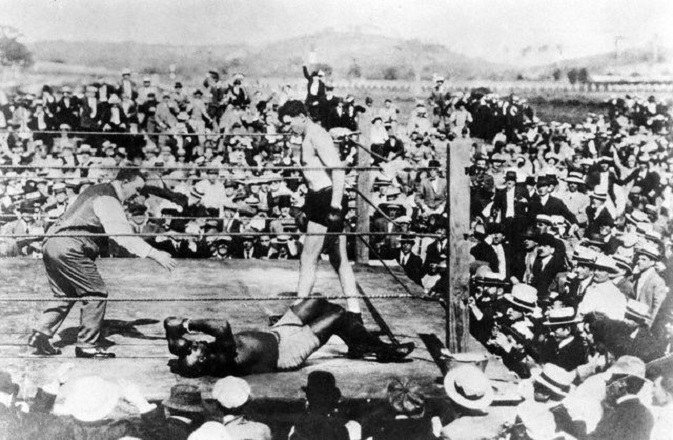
But land it he did. In round 23, he finally caught Corbett with a short, stiff right hand just as Corbett bounced off the ropes after having avoided a previous blow. It was enough to literally put Corbett’s lights out, as he drifted into unconsciousness before even hitting the canvas. Jeffries had caught his river card, big time.

This is how Jeffries kept the heavyweight title, which he would in fact never lose in the ring. Incredibly, Jeffries would suffer only a single defeat in his boxing career, that to the “Galveston Giant,” Jack Johnson, in another historic fight, long after he had forfeited his championship to retire to his alfalfa farm in California. Corbett, for his part, fought a couple more times, including a rematch against Jeffries, which he also lost by knockout. But that night in Coney Island saw Corbett give what many came to regard as, despite the outcome, the best performance of his career.       – Rafael Garcia Quiñones


McGuinness makes easy work of Major

May 13

United Promotions and Hennessy Sports teamed up for another great night of live boxing at the Hershey Centre in Mississauga, Ontario last night. In the main event, Logan McGuinness reduced an expected tough test to a mere tune-up as he routed Meacher Major, ending things in the second round.

McGuinness showed little respect for his opponent, attacking at the opening bell and putting Buffalo’s Major on the defensive. To the delight of the crowd, the fighters exchanged heavy artillery with Logan landing a devastating right hand that had Major in trouble midway through the round. Another straight right dropped Major who gamely got to his feet but just barely made it to the bell as McGuinness had him trapped on the ropes and taking a serious pounding. The second round began with similar fireworks as McGuinness looked to press his advantage while Major sought to desperately fight off his attacker. Major did tag Logan with a few good shots, one of which opened up a cut on the Orangeville, Ontario native. But the blood just spurred McGuinness on and his withering two-fisted assault soon had Major helpless in his own corner. The referee finally stepped in at 2:45 of the second round, giving McGuinness his seventh straight win as his record improves to 17-0-1.

On the undercard, cruiserweight prospect Denton Daley notched his sixth win in as many fights as he scored a sixth round technical knockout over Frank White, while the always exciting Samuel Vargas continued his win streak with a third round knockout over Arvydas Trizno of Hungary.

Stay tuned for a detailed report on Saturday’s big event at the Hershey Centre from BBB correspondent David Como.


Logan Puts In Work — Part 2

May 12

We get back to the Grant Brothers Gym, pull into the parking lot and there’s Aries at the door again, still hunched over, trying to figure out why the key isn’t working. Only now, there’s about ten other guys around him, everybody waiting to get inside, get to work.

Logan walks over to the group, starts chatting. Jess and I stay in the car, not sure what to do. I tell her she should take a picture of the guys. They’re some tough-looking dudes and she’s a bit nervous to interrupt them talking, but we go over and ask if they mind getting together for a photo.

Aries says, “Just don’t make the caption ‘Fucking Idiots Locked Out Of Their Own Gym.’”

A few of the guys start forming into a line at the top of the steps, Jess setting up the shot. Behind us, a car speeds into the lot and somebody says, “It’s RG.”

“He looks pissed …”

“Don’t take a picture of us getting balled out …”

Car door opens and out comes RG. He looks a bit a like Ja Rule, with bigger eyes. He’s got a smirk on his face. Turns out the locks on the gym door were changed and RG’s the only one with the new key. He’s just come from giving a high school motivational talk, relating the strategies one employs in the ring to those required for conquering obstacles in school and life. He does a lot of such mentoring programs, feels it’s important to show at-risk youth there are always options, choices.

Logan and the boys were to have started training at 11:30, it’s now almost quarter to twelve, but RG is gracious enough to get in the photo before hustling everyone inside. Jess and I follow and Logan disappears to get changed. The gym is stark, industrial – big open matted floor with a line of heavy bags where you enter, one wall all mirrored, fluorescent tube lighting hanging from an unfinished metal ceiling. There’s a boxing ring and an MMA cage beside each other.

The MMA guys are quick to get training, barefoot and huge, grappling without much warm-up or stretching. Aries and another boxer begin skipping rope. Logan comes out and starts an elaborate head and neck workout, shaking, nodding vigorously, getting the muscles loose. Jess and I sit on a bench against the wall, taking the scene in. We could be anywhere, anytime. Feels like it could be the ‘40s, young boxers throwing punches in the mirror, heads full of big brutal dreams.

RG watches Logan, checks his phone, gets an iPod running through the speakers. I go over to him, ask if we can talk about Logan and the fight coming up on Saturday. He takes me into the gym’s office, sits down across the desk from me. He’s an energetic, affable kind of guy, gets you laughing. The Grants have had the gym going there in North York for three years now. RG’s worked with a lot of different fighters, different styles.

He was approached by Logan’s people shortly after the fight with Gaudet, and admits that he was initially a bit hesitant to work with McGuinness because he was coming from such a different training background. RG says it’s like a culture clash, thought it might be difficult to get a relationship going with the kid. But he was won over by Logan’s work ethic, his willingness to put in the time. There’s no doubt in his mind McGuinness is going to be world champ. Logan has the discipline, the desire, the strength of mind. All he needs to do, RG says, is stop being so goddamn tough. “Don’t just be tough,” RG says, laughing. “You got to put that away, use it when you need to use it. I’ve got to get him to love defense.”

Logan is a warrior, but that doesn’t mean every fight needs to be a war. It can be fun too, says RG. That’s what they’re working on, developing a slick combination of brute force and solid footwork, effective defense. RG wants Logan to develop his visual preparation, to see the shots before they come. He knows Logan can take punches, has a strong chin, but he wants to get him to a place where this isn’t on display every fight.

You can tell RG believes in Logan, is psyched to be working with him. Says Logan is the type of fighter people want to come to see. He’s marketable, exciting to watch, a really entertaining boxer. “For the type of small individual he is,” RG says, “Logan fights like a big man.” Yet when you meet him, Logan is very soft-spoken. Gentle, humble. RG was impressed with this cool demeanor, and it’s made their working relationship come together very quickly. And in a sport like boxing, time is of the essence. “Now’s the time to make big things happen,” RG says to me, standing up and shaking my hand. “Just look out the window, man. It’s springtime. Things are blooming.”

We go back into the gym and RG crosses the mat, gets to working with the fighters. Jess and I watch Logan shadowboxing, firing off jabs … his training day just beginning. We leave them to their work, slip out of the gym quietly.

Photos by Jess McCauley

Driving back into the city, I’m almost envious of the day Logan has ahead of him. He’s got a whole team working with him, telling him what he needs to do, helping him get it done. My afternoon is empty, the road ahead hazy and undefined. I wonder if I could keep to such a rigorous schedule, have enough trust and discipline to follow my trainer’s commands.

Logan’s maybe the first guy I’ve met who really has a calling, believes in it, is willing to do whatever it takes. He’ll follow directions, take the punishment, work all day long. While I’m sitting in the passenger seat, thinking about what to eat.

We pull into an Italian sandwich shop and Jess backs over a pylon in the parking lot. We get the food and leave. The guy working there comes out and stands in the lot, holds the pylon in his arms like a baby while he watches us drive away.

We get back downtown and Jess drops me off. I go upstairs, grab a beer from the fridge and sit by the window in my room, looking down on the alley behind the house. I unwrap my sandwich – breaded veal, extra cheese, mushrooms and onions. I take a big bite and a sip of beer. Might watch the Jays game later. Or nap.

While back up in North York, Logan McGuinness is sparring, sweating. Pure determination and drive. A different world, a different life. So learn his name, go see him fight. There’s not many like him left.             – David Como


Big action weekend for top Canadian prospects

May 11

Claggett (right) is gunning for three straight wins.

A trio of Canada’s most promising young boxers will be in the ring this weekend. Tonight professional boxing returns to the city of Calgary in what has been dubbed “The Year of the Dragon.” Steve “The Dragon” Claggett (13[8]-1-1) looks to continue his rapid rise through the light welterweight ranks in his bout with Hungarian Laszlo Robert Balogh (14[7]-10-1).

Having won his last two fights by knockout, Claggett will be working to erase the memory of his heartbreaking, final round stoppage in the Philippines against Romeo Jakosalem. Claggett has spent much of this year at the world renowned “Mayweather Gym” in Las Vegas where he has been turning heads with his all-action style. In March the Chinese-Canadian upstart spent six weeks as the primary sparring partner for Zab Judah, putting in over fifty rounds of work with the former world champion. The toughest test for the young Canadian this weekend might be not underestimating Balogh despite his modest record, as Balogh’s last four opponents have a combined record of 50-1-1. A win on Friday night could mean the start of a big year for “The Dragon”.

The Hershey Centre in Mississauga will be the centre of attention in Canadian boxing on Saturday as both Logan McGuinness and Samuel Vargas will see action. In the main event, McGuinness (16[8]-0-1) makes his first defence of the NABA super featherweight title against Meacher Major “Pain” (20[17]-4-1) of the Bahamas. This marks the first time the young Canadian steps into the ring since his thrilling 11th round knockout of former world title challenger Benoit Gaudet. Down on all three scorecards, McGuinness showed tremendous heart in slugging out a late surprise knockout to claim the title. He’ll have to show that same tenacity against the hard throwing Major, who has knocked out thirteen opponents within three rounds. The Orangeville, Ontario native will have to be at the top of his game to outbox and outlast his opponent in a main event that promises lots of fireworks.

Samuel Vargas

Speaking of fireworks, headlining the undercard this Saturday is Colombia native Samuel Vargas (10[4]-0-1). Since a disappointing majority draw against Tebor Brosch, the Colombian has knocked out his last three opponents, most notably a first round stunner against Manolis Plaitis for the NABA Canada welterweight title. His opponent this weekend is Frederic Serre (12[3]-6) of France, a former French national champion and IBF International challenger, who brings a wealth of experience to the ring against Vargas. With an impressive showing on Saturday, Samuel will be working his way closer to a shot at a major title.      – Dustin Alexander


Logan Puts In Work — Part 1

May 10

Grant Brothers Gym in North York, Ontario

Jess and I get to the Grant Brothers Gym in North York about 10:30. There’s a young guy up on the steps, bags of gear around him on the ground, trying a key in the front door. Jess lights a cigarette and we watch the guy struggle with the door for a couple minutes before I get out of the car and walk over.

He introduces himself as Aries, says he’s a boxer. I tell him I’ve come to meet Logan McGuinness and ask if Logan’s inside.

“No, nobody’s in there yet,” Aries says. “I can’t unlock the fucking door. I’m supposed to open the place up today.”

Then he hands me the key, asks me to give it a shot. I look at Aries’ arms, big pulsing things, tattooed. I think, man, he’s going to feel dumb when I open this.

I jiggle it around, but nothing’s moving. I even get fancy, try unscrewing the casing around the lock. Aries just watches me. I give up.

“I’m going to make a call,” he says, and I go back, get in the car with Jess.

We sit there a few minutes, playing with her camera. A little white sedan pulls in next to us. I look at the driver — grey sweatsuit, close-cropped hair. I recognize his jaw and the flat, slightly collapsed bridge of his nose. I tell Jess, that’s him.

“Who?”

“Logan.”

Logan Cotton McGuinness from Orangeville, Ontario. NABA Super Featherweight Champ, 16-0-1 with 8 KOs. He’s 24, a pro for four years. I’ve been watching footage of him for the past couple days. I don’t know why, but I picture him laying me out in the parking lot with a left hook when I approach.  That’s in my head as I get out of the car and walk over.

But he’s expecting me. His new trainer, “RG” (Ryan Grant, the youngest of the Grant brothers) told him I’d be coming. We shake hands, go over to the door where a few more fighters have gathered. Nobody can get it open still.

Logan suggests we talk at a coffee shop down the road. He gets in his car and Jess and I follow. I was a bit intimidated to meet him, but somehow it feels natural to go for coffee with him. He makes us feel comfortable, even tries to pay for our coffee. He doesn’t have one, but drinks some kind of green-tea latte instead. I guess fighters don’t drink coffee.

And this is what we talk about, the lifestyle necessary to be a successful professional fighter – the sacrifices, the necessary mindset, where the body becomes a machine to be fueled, adapted, strengthened. Since his early teens, McGuinness trains five, often six days a week at the gym, plus roadwork.

Logan McGuinness (photo: Jess McCauley)

This is his life. He trains throughout the week and on Saturdays visits his family in Orangeville. He has little time for anything else. When he’s preparing for a fight he cuts out the downtime in Orangeville altogether and goes into seclusion, renting a hotel room the week before the bout, mentally preparing himself. He likens the mindset to that of one about to go to war. He can be irritable around his family close to a fight, finds it hard to answer questions, convince his mother the bruises on his face aren’t serious.

Listening to him, you sense his great love for boxing. He knows the history, can call up statistics. The sport consumes him. At the age of 14, he saw his brother fight as an amateur and he took it up shortly after. He watched old fights, devoured videos of classic matches, all the while training, hitting the gym every day after school.

He turned pro in 2008, fighting on the Andy Lee undercard in Limerick, Ireland. In 2010, captured the NABA lightweight title by defeating fellow Orangeville native, Buzz Grant. He’s maintained an undefeated record, and is putting this on the line, as well as his NABA super-featherweight belt, this Saturday night against Meacher Major at the Hershey Centre in Mississauga.

Logan says people like to see him in the ring because his fights are always dramatic. In his last match, Benoit Gaudet took the first seven rounds before Logan won with a come-from-behind knockout. He rallied in the eighth, gathering momentum, and put Gaudet down in the eleventh with an impressive three-punch combination to the jaw.

The fight before this was the exact opposite. McGuinness was winning handily before his opponent, Daniel Ruiz, turned the tables on him, unleashing a brutal, practically unanswered assault in the final rounds. Logan was seemingly out on his feet, but he didn’t go down. Even though it wasn’t his finest moment in the ring, McGuinness says it’s the kind of fight the fans like to see. He’s an action-fighter, a boxer who comes forward, presses his opponent. But he’s learning, knows he has to work on his defense.

This is one of the reasons he decided to train with RG of the Grant Brothers Gym. He feels RG can help him develop a slicker, more intelligent style of fighting. There is no doubt Logan has the power and the will, but RG is teaching him finesse, mechanics. The match against Meacher Major is McGuinness’ first fight since he began training with Grant. Major has a 20-4-1 record, with 17 of his wins by knockout. He will likely prove McGuinness’ most difficult opponent to date.

I ask Logan if he has any particular gameplan going into Saturday night, any special preparations.

“That’s RG’s department,” he says.

I want to meet this trainer, so we pay for the coffee and head back to the gym, hoping somebody figured out how to open the door.            

– David Como


Looking Ahead

May 9

Fans had eagerly looked forward to Khan-Peterson II.

In the fight game, things have a way of going south, and in a hurry. Those of us who, because of strange, masochistic tendencies, remain dedicated fans of this chaotic mess otherwise known as professional boxing, had barely any time to bask in the glow of a truly inspiring main event this past Saturday night before word came down that the rematch for one of 2011′s best fights was in jeopardy. Lamont Peterson, who insisted on random drug testing for himself and Amir Khan ahead of their scheduled May 19th rematch, has tested positive for steroids. The fight, surely one of the best matches of the year, will now likely not happen, at least not anytime soon.

Just a few months ago, things looked so promising for fight fans. The slate of big, exciting matches scheduled for 2012 was nothing short of drool-inducing: Rios vs. Gamboa, Alexander vs. Maidana, Ortiz vs. Berto II, Cotto vs. Mayweather, Khan vs. Peterson II, Pacquiao vs. Bradley.

Brandon Rios-Yuriorkis Gamboa fell apart when Gamboa backed out, citing dissatisfaction with the terms of the contract, and forced Top Rank to scramble to find a suitable substitute. They settled on Richard Abril and not often does a sport inflict two black eyes on itself with one event, but boxing did just that when Rios and Abril put on an incredibly dull fight and then the judges gave the victory to the boxer who had just been completely outclassed, Rios.

Abril vs. Rios: a fight that should not have happened.

Before that, Devon Alexander vs. Marcos Maidana turned out to be a surprisingly one-sided affair with Alexander taking a unanimous decision. Ortiz vs. Berto was then postponed because Berto injured himself in training. Now Khan-Peterson II appears to be off.  Add to that Floyd Mayweather Jr. going to jail in a few weeks and suddenly what looked like an exceptional year for the sport is slowly turning into a typical year, which means plenty of disappointment and nonsensical foolishness that effectively alienates so many potential fight fans.

What lies ahead? Well, thankfully, Ortiz vs. Berto seems to be back on track for June 30. Before that, we have Pacquiao vs. Bradley on June 9, albeit with a rather underwhelming undercard. Mayweather will be in jail for at least 87 days starting June 1. A couple of pointless heavyweight fights that can do the sport little good will take place during that time (Klitschko vs.  Thompson; Haye vs. Chisora). Jean Pascal finally returns to the ring against Tavoris Cloud. Juan Manuel Marquez is scheduled to fight someone in July but the hunt for a suitable opponent seems to be going nowhere. Similarly, in September Canelo Alvarez, fresh off his one-sided drubbing of the totally shot Shane Mosley, will, we hope, finally face a live body who can help us figure out just how good the Mexican phenom really is.

Thriller with Cotto only increases the appeal of Mayweather-Pacquiao.

By then Mayweather will be out of jail and hopefully, barring Timothy Bradley pulling off the upset, some earnest negotiations will finally take place to make Mayweather vs. Pacquiao a reality. While this match, for some, no longer holds the appeal it once did, the sport of boxing has painted itself into a corner. With Mayweather’s thrilling battle against Miguel Cotto in the books, the pressure to make the biggest match of them all only increases. Yes, Pacquiao could opt to take on Marquez again instead, and there’s no question Dinamita deserves the opportunity. But we’re reaching make-or-break time for Pacquiao vs. Mayweather and the hope here is that 87 days in the county jail may cause Floyd to fully understand this. His legacy will not be complete without a showdown against the Pacman and the fact is, there’s really no one else left to fight. Come this fall, it’s Mayweather vs. Pacquiao, or boxing continues its slow decline toward irrelevancy.

— Robert Portis


TWIBH: May 5, 1973 — Jofre vs. Legrá

May 7

Éder Jofre

Boxing comebacks are usually a bad idea. Boxing comebacks involving former world champions over the age of 35 are, George Foreman notwithstanding, almost always a terrible idea. One of the great exceptions to this took place almost 40 years ago and firmly enshrined the greatness of Éder Jofre.

By 1960, Brazil’s Jofre already had established himself as an outstanding world champion. He was a smooth, smart boxer who favoured an aggressive bobbing and weaving style. With excellent power in either hand, an iron chin, terrific stamina and great body punching skills, Jofre was as complete a fighter as the sport has ever known. He put together one of the longest unbeaten streaks in boxing history, from 1957 to 1965, in the process winning the world bantamweight championship and notching nine successful defenses. To this day, he is regarded by most boxing experts as the best bantamweight of all time.

In 1965, Jofre traveled to Japan to face another great bantam, Fighting Harada. By this time it had become a difficult ordeal for Jofre to make the weight limit and Harada won a close, 15 round decision, ending Jofre’s unbeaten streak. A rematch one year later yielded an identical result. Crestfallen, Jofre retired.

Three years later, to the delight of his Brazilian fans, “The Golden Bantam” returned to the ring, now as a featherweight.  The boxing experts, citing the long layoff and the fact that Jofre was now 33 years old, waved a collective finger and clucked their disapproval. Boxing is a young man’s game, they said. Too many great champions return only to diminish their legacies. But Jofre knew he could still compete. Over the next two and a half years he reeled off 14 straight wins, putting himself in title contention.

José Legrá

José Legrá of Cuba had just won the vacant featherweight title by defeating Clemente Sánchez and most viewed him as a dangerous opponent for the aging veteran. A sharp punching slickster, Legrá was known as the “Pocket Cassius Clay” because of his quickness and flashy style. He journeyed to meet Jofre in Brazil, gamely defending on the challenger’s turf.

The bout was a close affair, pitting the younger champion’s speed and sharp punches against Jofre’s constant aggression, power and boxing smarts. In the early rounds Legrá appeared to have an edge, his sharp jab with the hard right behind it forcing the challenger to give ground. But Legrá’s willingness to trade gave Jofre the opportunities he needed to connect with his heavier, more compact shots. As the rounds flew by and the sell-out crowd grew more fervent, Jofre gradually gained the advantage while the champion tired from the fast pace. Jofre’s greater accuracy and better timing proved the difference. While all agreed the fight was close, the title changed hands by a split decision in favour of the Brazilian legend, who added yet another milestone to his Hall of Fame career. And demonstrated that sometimes a comeback can be a great idea.

Robert Portis


A Hell of a Show

May 6

Would it really have been better four years ago?

Back in late 2007 there were hopes in the welterweight division about a potential clash between then undefeated Miguel Angel Cotto and Floyd Mayweather Jr. Money-May had just dispatched Ricky Hatton (via epic left hook with a stopover at the ring post) and Cotto had disposed of a still very game Shane Mosley in a classic war about a month earlier. So when Floyd decided to announce a retirement after the Hatton fight, some people accused him of ducking Cotto, while others just lamented the fact that Mayweather-Cotto wouldn’t be happening.

But last night at the MGM Grand Garden Arena in Las Vegas, Miguel Cotto and Floyd Mayweather Jr. finally met inside the ring and went to war for 12 rounds. Punches flew, blood spilled, and fans cheered, but after 36 action-packed minutes, “Pretty Boy” walked away with the decision. Cotto, however, put on a vintage performance of determination and courage, which made for a dramatic fight. Miguel is now a member of a select group of fighters (Márquez, de la Hoya, Hatton, Mosley) who have faced the two best fighters of this generation, and put the test-obsessed Mayweather to what was perhaps the toughest test of his career.

And that is no small feat if you remember some people considered this fight a mismatch to the tune of Mayweather-Gatti; Cotto certainly proved them wrong. The Puerto Rican kept up the pressure throughout much of the night, propelled forward by his will to win and his new-found confidence in himself and in his team. His strategy took the best of Jose Luis Castillo’s and de la Hoya’s gameplans when they fought Mayweather and melded them into a plan of attack that almost worked. In the first Mayweather-Castillo fight, the Mexican focused on making the combat as rough as possible, using his larger size to wrestle with Floyd and to push him back against the ropes. De la Hoya, on the other hand, relied on his left jab when he fought Mayweather. As a converted southpaw, de la Hoya had one of the strongest left hands around, and found some success against the defensive wizardry of Mayweather by jabbing and hooking to the head and body.

Miguel Cotto, being both heavier (and thus, presumably, stronger) than Mayweather, and a converted southpaw, used both of those strategies in trying to deal with the puzzle that Floyd is. To see Cotto at his best, look no further than the eighth round of last night’s fight, when he cornered Mayweather and successfully landed flush right hands and strong hooks and jabs to the face and body of Mayweather. It’s hard to remember Mayweather ever losing a round so definitively. And after round eight, a strange, almost bewildering image appeared before us: Floyd’s face splattered with his own blood. He managed only a sheepish grin to try to hide the fact that he was getting more than he ever bargained for from the tough Puerto Rican.

Of course the difficulty for Cotto was that he just couldn’t replicate what he did during the eighth round often enough to win (this observer scored the fight eight rounds to four in favour of Mayweather). The contest started out with Mayweather in control, keeping the fight in the center of the ring and landing straight right hands on Cotto’s temple, past and around Miguel’s left hand glove in order to make it count. Floyd’s speed doesn’t seem to have diminished much with age, which is remarkable given the fact that he’s now 35 years old.

But going by what we saw in the middle rounds, Mayweather’s ring mobility has taken a hit. Instead of circulating and minimizing the risk of getting caught by Cotto’s left-hand jabs and occasional hooks, he decided to stand by the ropes more often than he used to in past fights, countering with precise right crosses during and after Miguel’s attack. But Cotto kept coming forward, applying crippling pressure on Mayweather, backing him up physically and unloading a hefty amount of punches. Of these, only a fraction landed cleanly, but even the ones Floyd deflected or caught with his arms and body served to remind him that this was no sparring match, this was a real fight.

In the championship rounds, however, Cotto slowed down a bit. He was no longer able to put the heat on Floyd as he had before, and Money took advantage of it. He unleashed quick combinations of punches, the lead right hand followed by the left uppercut being a very effective one. Round twelve was all Mayweather, who took offensive command of the action and landed flush uppercuts on Cotto, buckling his legs. When the final bell rang, both guys embraced and traded words of respect and recognition. They had put on a hell of a show, and they knew it.

In the post-fight interview, Floyd stated that he decided to take more risks–in other words, allowed Cotto to manhandle him a bit–in order to “give fans what they want”. This statement can only be taken at face value; while it is certainly a plausible scenario, the simpler explanation is that Miguel succeeded in putting Mayweather under pressure the likes of which he hadn’t seen in a long, long time. Cotto decided to leave the ring without giving an interview, in disgust with the scorecards turned in by the judges, all of them in favour of Floyd by six (on two cards) and seven points.

When it was all said and done, fans of all stripes had something to cheer for last night. They saw two future hall of famers still fighting at an elite level put on a truly exciting show. It took all of Mayweather’s skill and experience to fend off the attacks of the rugged Cotto, and it made his win one of the most spectacular of his career. Cotto, on the other hand, loses nothing by failing to get the win. There’s no shame in losing to Mayweather, and even less so after giving such a display of heart.

That being said, Cotto has been through yet another taxing war that may affect his long-term prospects in the ring. For his next outing, he would benefit from working more on his stamina; fading towards the end of fights has always been an issue with the Puerto Rican. Conveniently, his current trainer specializes in conditioning. Additionally, now that he’s no longer under contract with Top Rank, Miguel has several intriguing options at 154 pounds: there’s the rising star Canelo Alvarez, who consistently pummeled Shane Mosley for 12 rounds last night (hopefully retiring him in the process), and there’s the ferocious puncher James Kirkland, who has slowly but surely climbed up the rankings of the division.

For his part, Mayweather will be “out of circulation”–to quote HBO’s Larry Merchant–for three months starting in June, but will still have big fights to look forward to when he gets back. Besides the obvious choice of the Pacquiao-Bradley winner, the lightning-quick Amir Khan is a possible rival if he gets past Lamont Peterson in the rematch. Or perhaps the strong Andre Berto if he bests Victor Ortiz in their second fight.

Whichever way these two champions decide to go in the future, last night they proved beyond any doubt that they deserve the attention of boxing fans. If and when they decide to fight again, we’ll be watching.      – Rafael Garcia Quiñones


Where’s the buzz?

May 4

Two days before the big Mayweather-Cotto PPV showdown and I have not caught the usual big fight fever yet. Is it just me? — boxing writer Martin Mulcahey on twitter

Two of the best in boxing step into the ring this Saturday night with much at stake in terms of money, prestige, and future opportunities. Both men are coming off convincing wins in their most recent fights and both appear motivated and in excellent condition. And yet, as Mulcahey states, the usual big fight buzz is difficult to find outside of Puerto Rico. What is it about Cotto vs. Mayweather that fails to rouse the usual passions and anticipation?

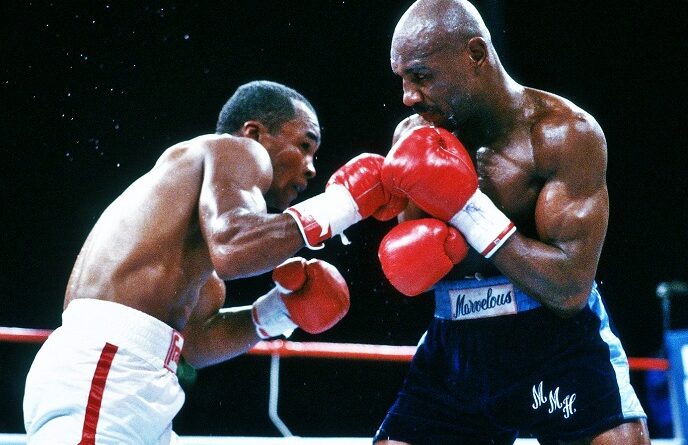
Not all big fights succeed in cranking up the excitement of the masses. Back in 1983, Marvelous Marvin Hagler defended his middleweight title against Roberto Duran. Here were two legends of boxing and two reigning champions going head-to-head for a world title, and yet, by fight night, the electricity level in Las Vegas couldn’t have powered a transistor radio. Hagler vs. Duran should have been a can’t-miss event, but it wasn’t. Similarly, Cotto vs. Mayweather, in boxing terms, should be a far more compelling match-up than say Mayweather vs. Mosley or Mayweather vs. Ortiz. And yet it doesn’t feel like it heading into Saturday night.

Duran vs. Hagler lacked the expected buzz.

The simple fact is, in a world where the public enjoys almost limitless options in terms of entertainment and diversions, a great fight in itself is no longer enough to command interest. To get that buzz, certain intangibles need to be in place, elements which have little to do with athletics and more with drama, mystery and the stories which human beings can never get enough of. The people behind professional wrestling have always understood this.

Simply put, neither Mayweather nor Cotto are, in and of themselves, hugely compelling personalities. Neither is Manny Pacquiao, for that matter. But a couple of years ago a Mayweather-Pacquiao bout would have been the biggest thing in sports. Why? Because a match between those two would have tapped into the human psyche, the collective unconscious if you will, as a battle between good and evil.

Pacquiao, with his endearing, overtly religious, and almost innocent persona, a champion who celebrates his victories by singing sappy pop tunes, contrasts perfectly with the angry and arrogant Mayweather, a complicated man with a penchant for hanging out with convicted criminals and beating up his girlfriends. It wasn’t just the fact that the fighters were, without question, the two top talents in boxing; the public’s appetite for the match, which would have likely made it the biggest grossing fight in boxing history, was all about the storyline, the drama, the never-ending conflict between the good guy and the bad guy.

Myth and mystery, not to mention racism, made Holmes vs. Cooney a huge event.

If such a potent plotline is not at work, then the other quality that creates big buzz is mystery — not so much a compelling story as a compelling question. For example, while Hagler vs. Duran failed to arouse the excitement of the public, Hagler vs. Leonard four years later did. Why? In both cases the oddsmakers pegged Hagler as the heavy favourite to prevail, yet in the Leonard match everyone wanted to know what was going to happen, in part because Hagler’s status had been greatly enhanced by his demolition of Thomas Hearns. The overriding question was simple: could Leonard somehow defy the odds? Could he overcome age, inactivity, and numerous disadvantages to pull off the upset?

Similarly, a palpable buzz surrounded Mayweather’s last outing against Victor Ortiz, not because it promised to be a great fight, but because people were intrigued by the questions: could the younger Ortiz compete with Mayweather? Was Mayweather in decline? Despite the fact that expert after expert told us Ortiz didn’t stand a chance, millions tuned in to see what would happen.

Every fight which transcends the sport of boxing, from Dempsey vs. Carpentier, to Louis vs. Schmeling, to Ali vs. Frazier contains these elements of either the inspiring story or the irresistible question. Or both. Take Larry Holmes vs. Gerry Cooney in 1982. At the time, this was arguably the biggest fight in boxing history because it combined both the immortal storyline — young, likable, pale-skinned Gerry Cooney vs. brooding, bitter, up-from-the-ghetto Larry Holmes — and the alluring question: can the unproven Cooney, whose true abilities remained a mystery thanks to having fought only six rounds in over two years, compete with the skilled, more experienced, undefeated champion? The fact that Cooney possessed devastating one-punch knockout power only added extra intrigue.

Cotto is perceived as being of little threat to Mayweather.

Looking at Cotto vs. Mayweather in these terms, the simple fact is we have no intriguing storyline and no enticing questions. The two fighters appear to genuinely respect one another, so there’s no bad guy vs. good guy scenario. And virtually no one gives Cotto a chance to win, in part because Cotto’s abilities are perceived as understood. Few expect the underdog, who really isn’t a star athlete outside of Puerto Rico, to do anything vastly different from what he’s done before, so there’s no hype around the question of “Can he do it?” Pretty much everybody accepts the idea, rightly or wrongly, that Mayweather is simply too good for the Puerto Rican champion. Similarly, no one expected Roberto Duran to defeat Marvin Hagler, while many couldn’t help wondering if Sugar Ray Leonard might somehow pull off the improbable.

But who knows? Anything is possible. And the best thing that could happen in terms of storylines and intrigue would be for Cotto to do what no one thinks he can do — win. If anyone deserves to pull off the big upset, it’s him. Then a whole new set of storylines and questions would arise following the fight, leading to new anticipation and more buzz for boxing, a sport that needs every bit of juice it can get.                   – Robert Portis


On 24/7

May 1

I feel a bit uncomfortable admitting this, but I would be lying if I said I’m not a fan of 24/7.

Yes, it is little more than a propagandistic device for HBO to sell its PPV events. It is often blamed for presenting a slanted view of reality, and with good reason. It too easily chooses to focus only on the biggest stars in boxing, romanticizing their dedication to the sport, glossing over their often chaotic personal lives, and almost completely ignoring the lower tiers of fighters that truly lead lives of hardship in and out of the ring. These are all valid criticisms, but the fact that this production is unadulterated propaganda does not automatically strip it of all value or even artistic merit.

24/7 can be highly engaging because, on the one hand, it’s that most effective kind of entertainment: escape entertainment. It allows us to look, even if through a very distorted glass, at people who lead lives far removed from the normal world. They are elite professional athletes who–before turning 30–have earned more money than most of us will see in our lifetimes. They deploy whole contingents of personnel to satisfy their every need, so that they can dedicate themselves exclusively to becoming better at beating up people. If this isn’t the ultimate male dream, I don’t know what is.

The prime focus of 24/7: beautifully shot training sequences set to swelling music.

But despite what Floyd Mayweather may have to say, 24/7 is at its best when it does what it does for every series, regardless of who the current participants may be. It thrives on training montages, on swelling music scores, and on Liev Schrieber’s carefully constructed monologues. More than once, after watching an episode (more like after every episode), I’ve felt like strapping on trainers and a hoodie to go for a run. Other times I turn to whoever’s closest and feint a couple of mean hooks. I find it almost impossible not to be moved in this way. The question is, why?

I believe the answer has something to do with the way 24/7 contributes to mythologizing the sport. An integral part of the narrative of every 24/7 series is the fact that boxing is a lonely endeavour. Yes, every fighter is surrounded by people: trainer, coaches, dietician, family, friends, leeches and well-wishers. But at the end of the day, the only one who goes through the whole grueling training program, and the only one who will be at the receiving end of his opponent’s punches, is the fighter himself.

Another 24/7 staple: the boxer and his entourage stride forward in slow-motion.

Still, the physical struggle of being a professional fighter may fall short of the psychic one. Fighters are men, and they are therefore constantly struggling with self-doubt. Is age finally catching up with me? Am I really as good as everyone says I am? By taking this fight, have I bitten more than I can chew? But fighters are men of action, and so at some point they learn to shut off the questioning voice inside their heads and focus on the task at hand: finish the run, pummel that bag, win this sparring match, get in that ring.

This is the myth that 24/7 pushes, and it does so confidently and effectively, because every myth is founded on at least some basis of truth. And the truth upon which 24/7 builds its romanticized view of training camps and of the fight game in general, is that boxing may be the toughest sport an athlete can choose to compete in. To make it to the very top takes a tremendous amount of will, persistence, mental toughness and sacrifice. And it is this undeniable truth that 24/7 celebrates.

– Rafael Garcia Quiñones